Daily tech roundup: Nvidia’s fallout widens, Signal walls off the AI snoops, and the robots walk away from Uber
Today’s through-line is trust breaking down at the top of the stack. Nvidia’s crisis moved from a leadership exit to a legal one, with California’s attorney general opening an investigation into whether advanced chips or confidential information reached China. Signal is drawing a hard line of its own, blocking AI assistants from reading what’s on your screen. And Waymo and Serve Robotics are cutting Uber out of the autonomous loop, betting they no longer need a middleman to reach customers.
At a glance
- Nvidia’s fallout widens — California subpoenas the company over the former CEO’s China ties, as new reporting questions the management culture behind his exit. (TechCrunch)
- Signal blocks AI from reading your screen — new screenshot restrictions keep Gemini, Siri, and other on-device agents out of your messages. (The Verge)
- The robots are ditching Uber — Waymo and Serve Robotics are ending their exclusive deals and going direct to customers. (The Verge)
Nvidia’s fallout widens
What happened: California Attorney General Rob Bonta said Thursday evening that the state has served an investigative subpoena on Nvidia, following reports that former CEO Jensen Huang had an affair with a woman the U.S. government believes is a Chinese spy. The state is investigating whether Nvidia’s advanced GPUs or confidential information may have been shared with China, and whether the company misled investors and the public about that risk. Huang resigned last week after further revelations of extramarital affairs with company employees, and new chair Harvey Jones said earlier this week that Nvidia has no intention of reinstating him. The board has hired a law firm and an independent slate of directors to investigate the extent of the damage, Congress is gearing up to question Huang — he has agreed to testify — and the SEC is said to be launching a civil probe into whether Nvidia’s public disclosures misled investors. Democrats have also opened an inquiry into the Trump administration’s handling of Nvidia’s chip sales to China. Separately, reporting in The New York Times describes a management style built on praise and fear: Huang reportedly told subordinates that Nvidia’s wealth made money useless as a motivator, so humiliation was the only lever left. The Times found a long paper trail, including a 2005 episode in which former HR chief Michael Winston threatened to sue and called Huang’s conduct the most abusive he had seen; Nvidia paid him more than $1 million. Huang’s spokesman calls the allegations fabrications. Thousands of employees have signed a letter asking for Huang’s return, and Elon Musk, speaking at the DealBook conference this week, compared the ouster to kicking Michael Jordan off the Bulls and said employees “love” him.
Why it matters for teams: Nvidia’s chips sit at the center of almost every AI plan, so a crisis that started as a boardroom story is now a vendor-risk and compliance story. A state investigation, a possible SEC probe, and a congressional inquiry all running at once means months of headlines and uncertainty around the company that supplies the hardware your AI roadmap depends on. The management-culture reporting matters too: it is a reminder that a single-leader dependency is a risk, not just a strength, and that the “indispensable founder” narrative can collapse fast.
What to watch: What the California investigation and the SEC probe actually find, and whether any of it touches chip supply or export rules — that is the part that could reach your procurement plans. Also watch whether Nvidia’s board investigation produces changes in governance, and how the company talks about leadership succession now that reinstatement is off the table.
Based on reporting by TechCrunch and TechCrunch.
Signal blocks AI from reading your screen
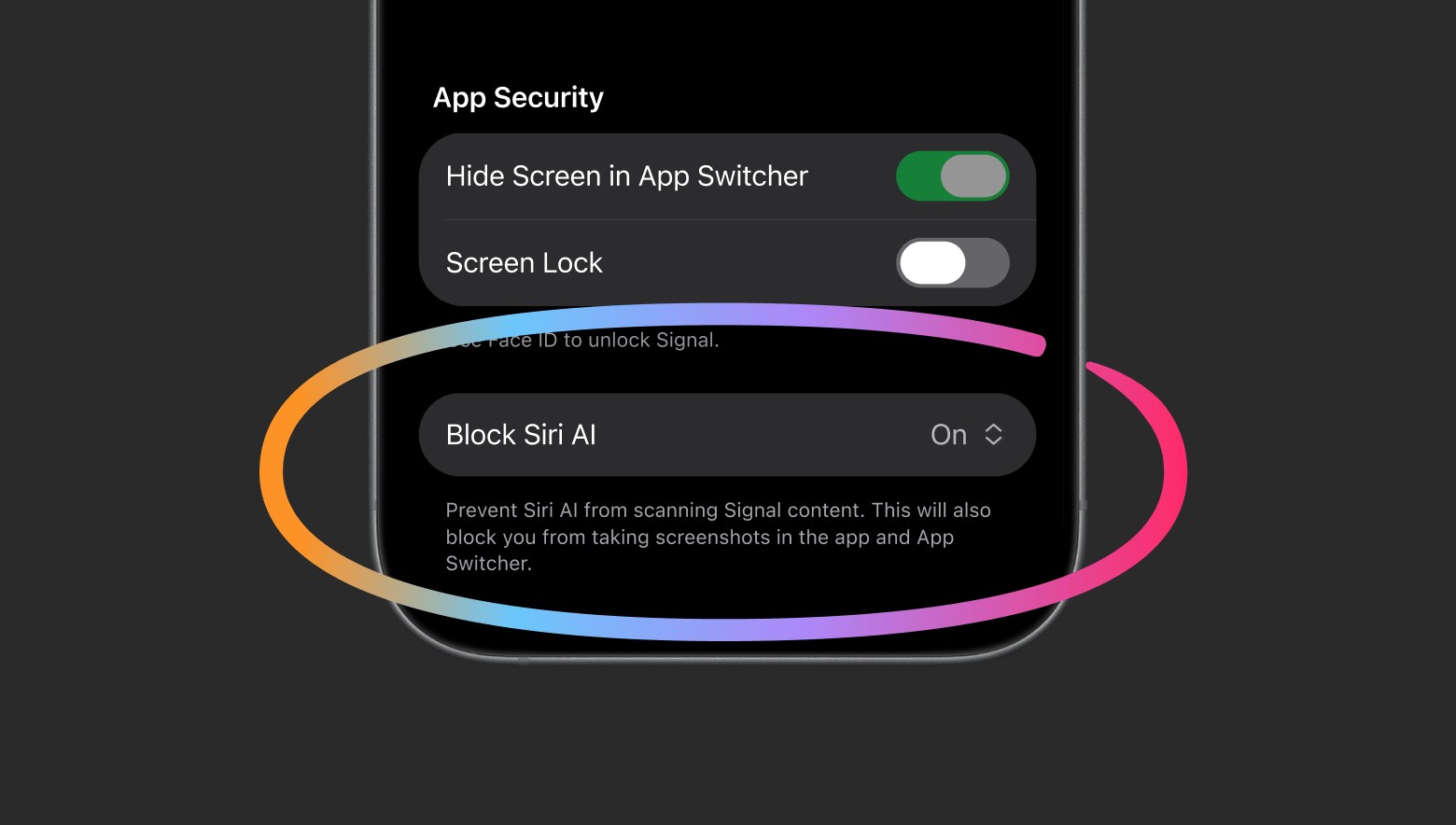
What happened: Signal is restricting screenshots in its app on Android and on iOS 27, in an effort to stop AI agents from reading users’ messages and other on-screen data. The change should keep Siri, Gemini, and other on-device AI assistants from scanning Signal content. Signal president Meredith Whittaker wrote in a blog post that agentic AI features built into operating systems, which analyze on-screen information to learn more about the user, are undermining Signal’s ability to independently guarantee privacy, and she urged OS providers to make it easier for app developers to control what data agents can access. The iOS setting is labeled “Block Siri AI,” and turning it on also blocks screenshots inside the app and in the App Switcher. Users can restore screenshot capability in Signal’s settings, but Whittaker warns that doing so could expose their — and their contacts’ — Signal content to these AI agents and break Signal’s privacy guarantees. She calls the screenshot-blocking fix incomplete, because it does not address other ways AI agents can reach app data, such as through the device filesystem, and she says the protections cannot currently be implemented on macOS.
Why it matters for teams: On-device AI that reads your screen is no longer hypothetical — it is a default feature of the phones your people carry, and it can quietly pull confidential conversations into an assistant’s context. If your team uses Signal (or any messaging app) for sensitive discussions, the boundary between “private app” and “AI-readable screen” has been blurry, and Signal is now forcing the issue. The deeper point Whittaker makes is aimed at platform owners: app developers lack good tools to stop agents from reading their apps without degrading the experience.
What to watch: Whether Google and Apple respond with better controls for developers, and whether other messaging apps follow Signal’s lead. In the meantime, if your team handles sensitive information on mobile, check whether the devices in use have AI screen-reading features enabled — and treat Signal’s new toggle as the model for what “private” should mean on a phone.
Based on reporting by The Verge.
The robots are ditching Uber
What happened: Waymo and Serve Robotics are walking away from their exclusive deals with Uber. Waymo co-CEO Tekedra Mawakana said in an interview that Waymo plans to end its exclusive robotaxi partnership with Uber, describing the mixed-fleet experience as a “crapshoot” for its own customers. Starting in January 2028, riders in Austin and Atlanta will be able to hail driverless rides directly through the Waymo app. The reversal is striking because just weeks earlier, in a late August earnings call, Uber CEO Dara Khosrowshahi called the partnership “very strong,” noting the companies had worked together for years in several cities — including exclusively in Austin and Atlanta — and said he expected the arrangement to continue into next year. Serve Robotics, which operates thousands of sidewalk delivery robots in dozens of U.S. cities, has also announced it will not renew its partnership with Uber Eats when it expires in 2027.
Why it matters for teams: Autonomy has become a real commercial business, and the companies that build the robots no longer want an intermediary between them and their customers. For anyone planning around delivery, logistics, or urban mobility, the takeaway is that the platform layer is fragmenting: the “one app for everything” model is giving way to direct relationships, which means more vendor relationships to manage and more apps to integrate with. It also signals confidence from Waymo and Serve that their services can stand on their own — and a bet that customers will follow the robots, not the aggregator.
What to watch: Whether other robotaxi and delivery-robot operators follow the same path, and how Uber responds as its autonomy partners go direct. The January 2028 date for Waymo’s direct service in Austin and Atlanta is the first concrete test of whether riders switch apps when the cars are the same.
Based on reporting by The Verge.
The bottom line
Three different stories, one theme: the intermediaries are losing their grip. Nvidia’s board, California’s attorney general, Congress, and the SEC are all now second-guessing a company that once looked untouchable. Signal is refusing to let platform AI act as an uninvited middleman for your messages. And Waymo and Serve are cutting Uber out of the ride entirely. For teams, the practical moves are small but concrete: review your exposure to Nvidia-dependent AI plans, check whether on-device AI can read your team’s screens, and expect your mobility and delivery vendors to multiply rather than consolidate. Note: the two Verge stories sit partly behind a paywall, so this roundup covers the freely accessible portions of those articles.