Sunday’s tech news has a common thread: control. Who controls what happens on your screen, who controls the world’s most important chip company, and who controls the software inside the gadgets on your desk. Here’s what matters for teams.
At a glance
- Signal is now blocking screenshots on Android and iOS, pushing back against operating systems whose AI agents can scan your screen.
- Nvidia reported strong earnings while a public campaign pushes for Jensen Huang’s return — and the company is cutting off H200 chip sales in China.
- People are using AI coding tools to rewrite the software on their own gadgets, starting with a TV full of ads.
Signal limits screenshots as AI agents learn to read your screen
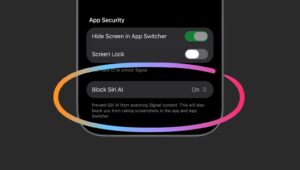
What happened: Signal announced Friday that it is limiting users’ ability to take screenshots inside its Android and iOS apps. President Meredith Whittaker described the move as a response to what she called an “existential threat”: operating systems that build in agentic AI capable of scanning whatever is on a user’s screen. Windows, Android, and macOS/iOS are, in her account, undermining Signal’s ability to guarantee privacy on its own. Once an OS-level AI agent captures screen data, that data can be stored and made accessible to whatever local database or remote server the agent uses — all outside Signal’s control, and implicating every participant in a conversation, not just the person whose screen was captured. Signal already blocked screenshots in its Windows app by default; the mobile change extends the same protection. Users can switch the restriction off, but Whittaker said doing so would break Signal’s privacy guarantees, and she admitted the fix is incomplete, since it does not address sneakier ways AI agents might reach app data.
Why it matters for teams: If your team relies on Signal — or any encrypted messenger — for sensitive conversations, the privacy promise now depends partly on the operating system, not just the app. OS-level AI features that read the screen create a new path for sensitive information to leave a device, one that your messaging policy probably doesn’t cover yet.
What to watch and do next: Check whether screen-reading AI features are enabled on company devices, and decide whether they belong there. Make sure staff know about Signal’s new setting, and treat screenshots as a data-loss vector in your messaging and device policies.
Based on reporting by TechCrunch: https://techcrunch.com/2026/11/21/signal-restricts-mobile-screenshots-as-it-confronts-existential-threat-of-ai-surveillance/
A tale of two Nvidias: strong earnings, a leadership campaign, and a China cutoff
What happened: Nvidia presented two very different pictures this week. On the earnings side, the company reported soaring revenue, beat expectations, and issued strong guidance, with interim CEO Colette Kress closing the call by assuring investors the current leadership has things under control. At the same time, a public campaign — including Elon Musk — is pushing for former CEO Jensen Huang to return, with a petition circulating and Huang himself saying he is prepared to come back. The company’s public stance is that it has no plans for a return, though its position on Huang has shifted before, and its falling stock price suggests Wall Street is not reassured. Nvidia also said it will no longer sell its H200 chips in China, and it is closing off the remote-access route under which data centers set up just outside China — in countries like Malaysia — were being used to access the chips remotely. Critics estimate that around 20% of Nvidia’s business ultimately traces to China through such indirect routes, so a serious cutoff could hit the bottom line, even as the latest quarter’s numbers look strong.
Why it matters for teams: Nvidia sits at the center of enterprise AI budgets. GPU supply, pricing, and export rules shape what your team can buy, run, and plan around — and a leadership fight plus a China cutoff means more volatility in that market.
What to watch and do next: Watch whether the board’s position on Huang holds in the coming weeks, and whether the China restrictions bite in the first half of 2027. If you have GPU procurement or AI infrastructure plans in the pipeline, build in room for price and availability swings.
Based on reporting by TechCrunch: https://techcrunch.com/2026/11/21/a-tale-of-two-nvidias/
Vibe-coding is coming for your gadgets
What happened: The Verge’s Stepback column argues that vibe-coding is moving from software to hardware: large language models now let ordinary users redesign and control their own gadgets. This is not a brand-new capability — people have been hacking, modding, and jailbreaking devices for years — but AI tools have made it easy enough that anyone can try. The column’s opening example is a developer in India who goes by Gathin T. Fed up with his Xiaomi Android TV’s ad-cluttered interface, he reasoned that swapping a launcher on a phone might work on a TV too. He prompted Claude Code, and with a couple of permission tweaks and USB debugging enabled so the chatbot could control the TV over the same Wi-Fi network, he stripped out the onscreen ads, simplified the interface, and made his PlayStation input easier to reach — in about 90 minutes. He shared the result on X, and it took off.
Why it matters for teams: The same pattern is heading for workplace gear. Employees will use AI tools to reconfigure devices, firmware, and interfaces without waiting for IT — fixing real annoyances fast, but also making unmanaged changes to hardware on your network.
What to watch and do next: Expect more AI-assisted tinkering with office hardware, from displays and conference gear to dev boards. Decide where that is welcome and where it crosses into unsupported territory, and remember the risk: a bad firmware change can leave a device unusable, so anything business-critical should stay on supported, tested configurations.
Based on reporting by The Verge: https://www.theverge.com/column/1039139/vibe-coding-gadgets-tv-camera
The bottom line
The screen you read, the chips you buy, and the gadgets on your desk are all becoming more open to AI — and less fully under any one party’s control. Signal is drawing a line around your messages, Nvidia’s future is suddenly an open question, and your own team may soon be rewriting the devices IT used to own outright. The practical move this week: review your screen-capture and messaging policies, keep an eye on GPU supply, and set a clear line on AI-modified hardware before someone crosses it for you.